
Editor's Note
Every grower who has priced a rain cover has heard the warning: “Put a cover over cherries and you’ll get more rot.” It sounds logical — cover a crop and the air gets still and damp. But when researchers actually measured disease under covers, the headline result went the other way. This article lays out both sides of the ledger: what the trial data says covers do to disease, where the real risks sit, and the management habits that decide which side of the ledger your orchard lands on.
The Short Answer
Measured across published trials, cherries under rain covers rot less, not more: brown rot and grey mould losses of 16.5–48% on uncovered trees fell to 1.8–11% under covers (Børve et al., 2003). The reason is simple — the fungi that rot cherries need wet fruit surfaces to infect, and a cover keeps the fruit dry. The risk is real but narrower than the warning suggests: in fully enclosed systems, heat and humidity build up and must be vented; in the open-sided row covers (techo) used for cherries, Chilean field measurements found humidity under the cover no higher than outside. The cover is not the risk. A closed cover with no ventilation management is.
New to rain covers? Start with the selection guide: → Cherry Rain Cover: How to Choose the Right Cover Before Harvest
Table of Contents
Why Wet Fruit Is the Real Enemy
The two rots that cost cherry growers the most near harvest — brown rot (Monilinia) and grey mould (Botrytis) — share one requirement: liquid water on the fruit surface. Spores land on cherries all season; infection takes off when rain or dew keeps the skin wet for hours at exactly the stage when the fruit is sweetest and the skin is thinnest.
That is why the cover’s disease effect is mostly mechanical, not chemical. Remove the rain from the fruit surface and you remove the infection window — the same window the cover closes against cracking. In the Norwegian trials summarised by Børve (2003), that single change cut rot losses from as high as 48% down to a 1.8–11% range, with no fungicide programme change underneath.
The honest headline: a rain cover is a disease-control tool that also stops cracking — not the other way round.
Where the Warning Comes From — the Real Cost Side
The “covers cause disease” claim is not invented; it is over-generalised from a different system.
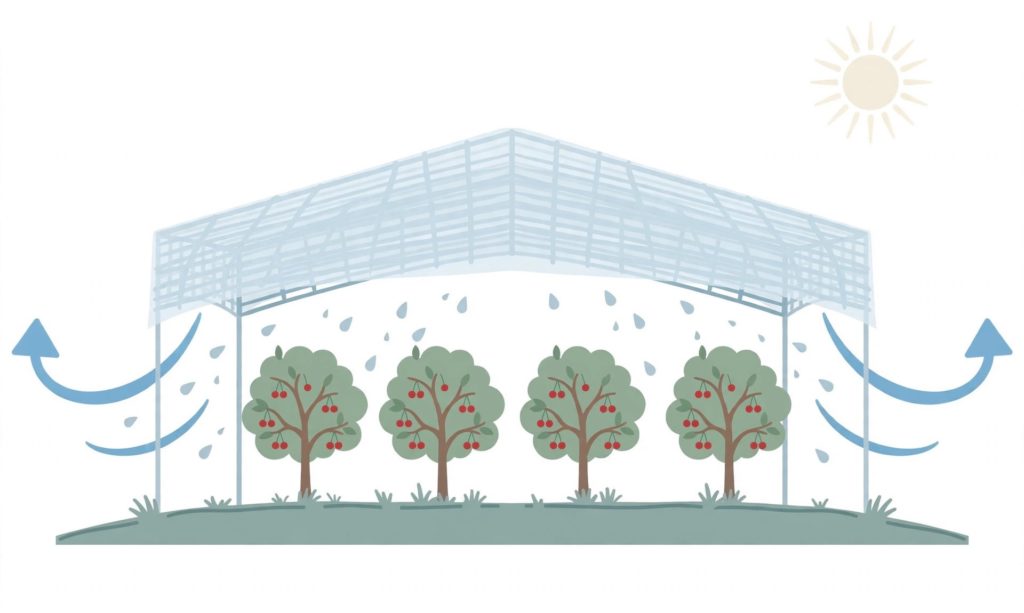
In fully enclosed covers and tunnels, the air exchange drops, temperature and humidity climb (a pattern documented since Simon, 2006, and reviewed in Frontiers, 2025), and fungi thrive once relative humidity sits at 90% or above — the threshold Chilean crop consultants watch under covers (Smartcherry, Casas interview). A sealed cover left closed after rain, in warm weather, can hold exactly the damp, still air those fungi want.
Three qualifiers decide whether that risk applies to you:
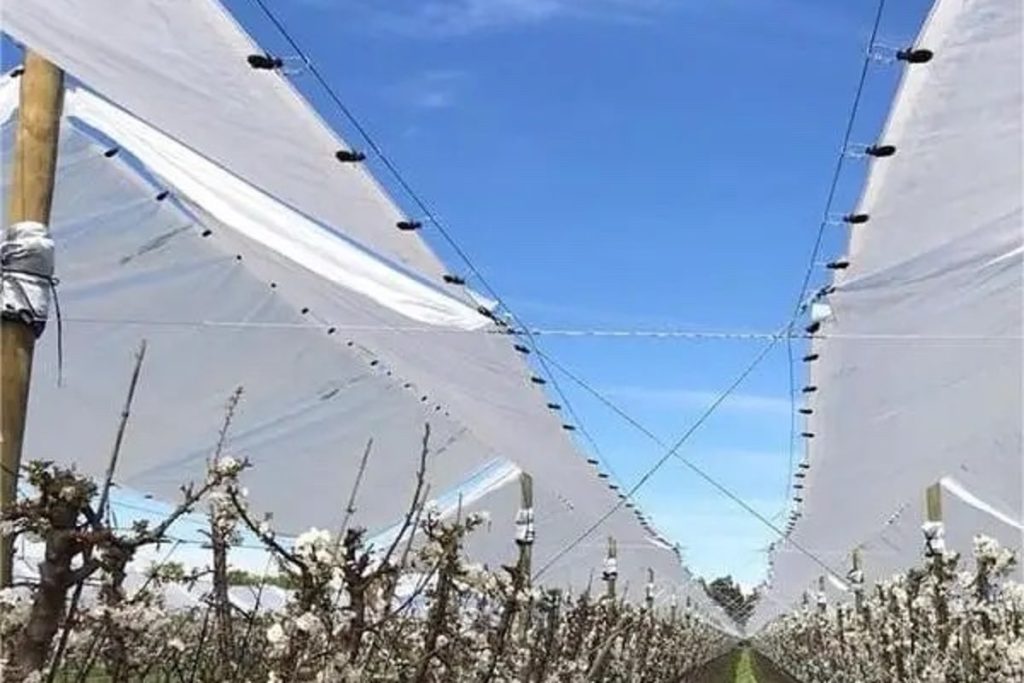
- Cover type. An open-sided techo over a cherry row is not a sealed tunnel. In commercial Chilean orchards, sensors under open-sided covers measured relative humidity in the upper canopy 4.7 percentage points lower than outside, with air temperature only 0.6 °C higher (Pino et al., Horticulturae, 2023). Wind still moves through the sides; the roof only stops the rain.
- Weather pattern. The risk window is warm, still, wet weather — not every covered day.
- Management. Every cost on this side of the ledger has a manual counter-move, listed in the next section.
Managing the Air: the Ventilation Checklist
- Open up after rain. As soon as the weather clears, open sides or roll the cover back enough to flush the humid air out.
- Never leave a closed cover sealed into a hot spell. Heat plus humidity is the one combination to avoid; if your system can open, open it before the heat arrives, not after.
- Check for ponding. Water sitting in sags on top of the cover drips, adds weight and keeps local humidity high. A correctly tensioned cover sheds it.
- Keep the spray programme. A cover reduces infection pressure; it does not replace your fungicide schedule. Plan spray access into the deployment timing — one more reason covers go on at colour change, after the main spray passes, not before.
- Remove on time. Covers come off right after harvest. A cover left hanging into the off-season only ages the fabric and shades the trees.
Disease Is Only Half the Side-Effect Ledger
Covering changes more than humidity. The same radiation reduction that keeps rain off also cuts the light and UV the fruit uses to colour — a real cost, and an uneven one: bicolour varieties such as Rainier pay more for it than red varieties. That trade-off, and how growers manage it, is covered in our companion article on rain covers and cherry colour.
FAQ
Will a rain cover increase grey mould (Botrytis) in my orchard?
The trial evidence points the other way: by keeping fruit surfaces dry, covers cut Botrytis and brown rot losses sharply (16.5–48% uncovered vs 1.8–11% covered, Børve 2003). The exception is a fully enclosed, unventilated cover in warm wet weather — manage the air, and the exception stays an exception.
Is an open-sided cover (techo) different from a tunnel for disease?
Yes. The humidity build-up documented in the literature is an enclosed-system problem. Under open-sided row covers in Chile, measured canopy humidity was slightly lower than outside (Pino et al., 2023), because air still moves through the sides.
Should I change my fungicide programme under a cover?
No — keep it. A cover lowers infection pressure by removing wetness; it is not a treatment. What changes is logistics: finish the main pre-harvest passes before the cover goes on at colour change.
What is the single most important habit under a cover?
Vent after rain. Every disease risk on the cost side of the ledger is a humidity-and-time problem; flushing the air as soon as the weather clears removes both.
Before You Enquire
If you are weighing a woven rain cover for cherries, the disease question to ask any supplier is not “will it cause rot?” — the data answers that. Ask instead: is the cover designed for an open-sided installation, how is it tensioned so water cannot pond, and how quickly can it be opened or removed after harvest? Our woven rain covers are built for exactly that open-sided techo form — see the specifications, eyelet options and trade terms on the product page.
Orchard Rain Cover — woven HDPE, UV 500 KLY, 5-year warranty