
Editor's Note
Most cherry rain covers are bought in a hurry — rain is forecast, the fruit is colouring, and there is no time left to compare options. This guide slows that decision down: it walks through the four choices that actually determine whether a cover saves your crop — when to put it on, how wide it needs to be, woven or film, and how it is managed while it is up and after it comes off.
The Short Answer
For most cherry orchards, the right cover is a woven HDPE rain cover deployed at colour change, three to four weeks before harvest, and removed right after harvest. Choose the width from your row spacing — standard widths are 1.8 m, 2.0 m and 2.4 m, with custom widths for wider canopies. Pick a film cover only if light transmission and anti-drip matter more to you than strength at the fixing points and re-use. The sections below explain each choice — including the costs of covering that most sellers leave out.
Colour change
When to deploy
3–4 weeks
Before harvest
1.8 / 2.0 / 2.4 m
Standard widths
5-year warranty
UV 500 KLY fabric
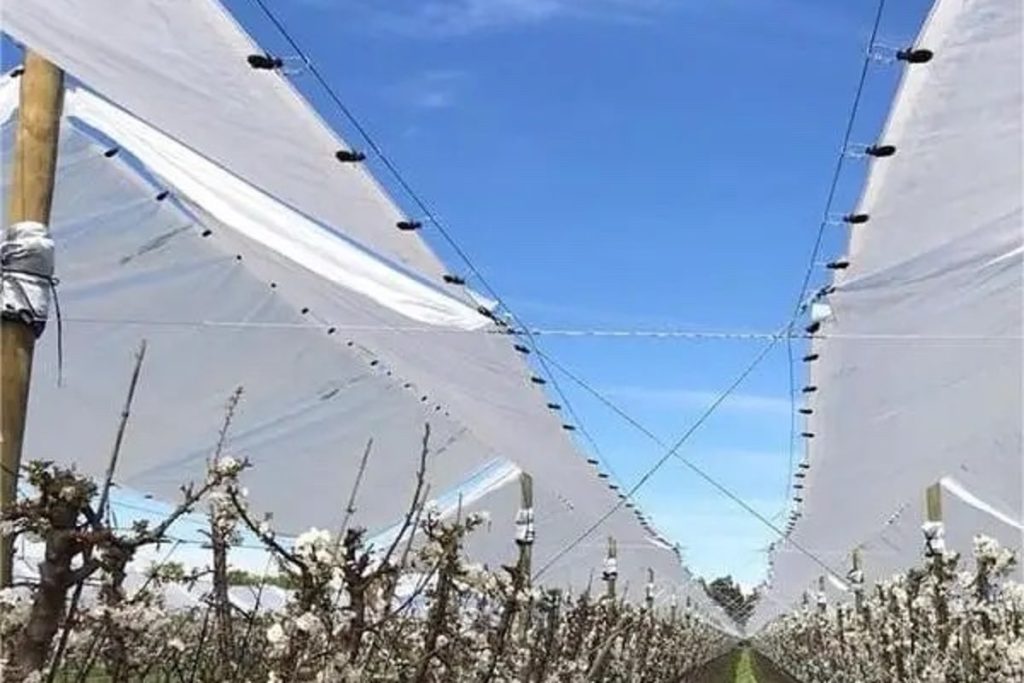
Table of Contents
Why Cherries Crack: Two Ways Water Gets In
A cherry close to harvest can crack through two channels, and a cover only controls one of them.
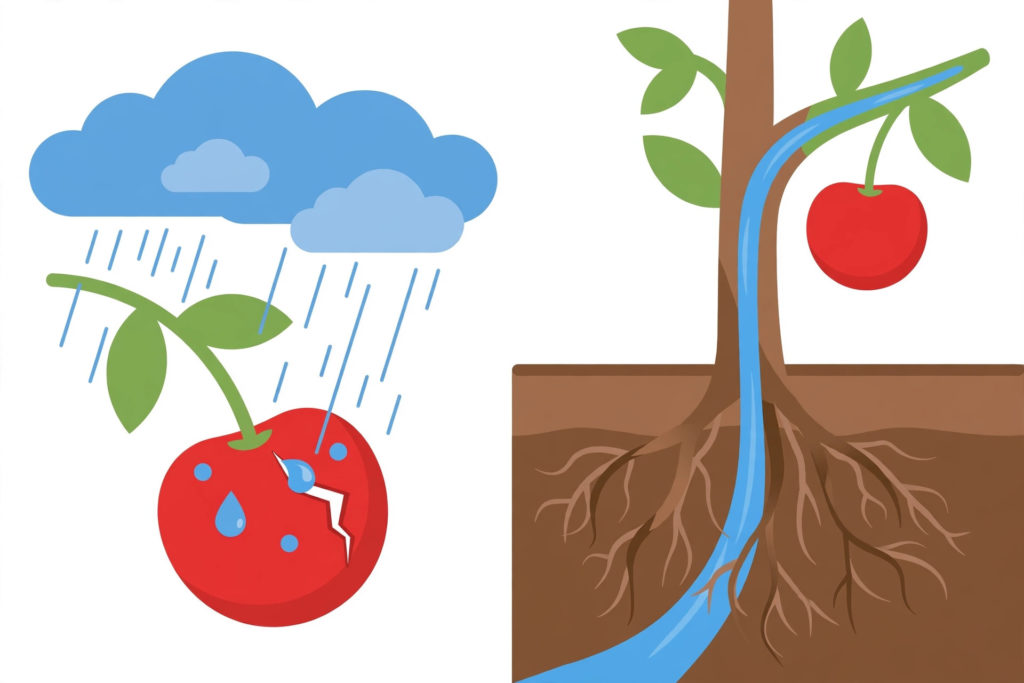
The main channel is the fruit surface: rain sitting on the skin is absorbed through microscopic cracks in the cuticle, the flesh swells faster than the skin can stretch, and the fruit splits. This is the channel a rain cover shuts off.
The second channel is the soil: roots take up water after heavy rain or over-irrigation, and that internal pressure can crack fruit even when the skin stays dry. No cover fixes this channel — it is managed with irrigation discipline and drainage in the weeks before harvest.
The honest conclusion: a cover is not a guarantee against cracking. It removes the bigger of the two risks during exactly the vulnerable window — from colour change to the end of harvest — and the soil side remains yours to manage.
Decision 1: When to Put the Cover On — and Take It Off
Two different jobs are often confused here. Installing the structure — posts, wires, supports — is winter or early-spring work. Deploying the cover over that structure happens much later.
Deploy at colour change, about three to four weeks before harvest. That timing is the standard treatment in published cover trials, and shorter versus longer covering periods showed no difference in rot protection. Earlier than colour change, the cover only gets in the way of spraying and orchard work. Later, the first damaging rain may already have fallen.
Take it off right after harvest. Leaving a cover on into the off-season shortens its life and shades the trees for no benefit. A woven cover is made to be taken down, rolled, stored dry and used again the next season — that cycle is part of its economics.
For Southern Hemisphere growers the window is easy to remember: in Chile, the main cherry harvest window runs from November to January (USDA FAS), so covers are deployed in the weeks just before, as the fruit colours. The standard Chilean form is the techo — an open-sided cover pitched over the row — and that is the form this guide assumes; a fully enclosed macro-tunnel is a different system with different behaviour.
Winter – early spring
Install the structure: posts, wires, supports
Colour change
Deploy the cover, 3–4 weeks before harvest
After harvest
Remove, roll and store dry for next season
What a Cover Does to the Air Under It
Covering changes the orchard’s microclimate, and the account runs in both directions.
The credit side is bigger than most growers expect. By keeping rain off the fruit surface, covers cut brown rot and grey mould dramatically — in published trials, rot incidence ran at 16.5–48% on uncovered fruit against 1.8–11% under covers. (Børve et al., 2003) Wet fruit is the main driver of harvest rot; a cover removes the wetness.
The debit side is real, and it depends on the cover type. A closed system traps heat and humidity, and fungi thrive when relative humidity stays above roughly 90%. An open-sided row cover ventilates by design — in Chilean field measurements, humidity under a row cover was no higher than outside, and sometimes lower. (Pino et al., 2023) The management rules follow from this:
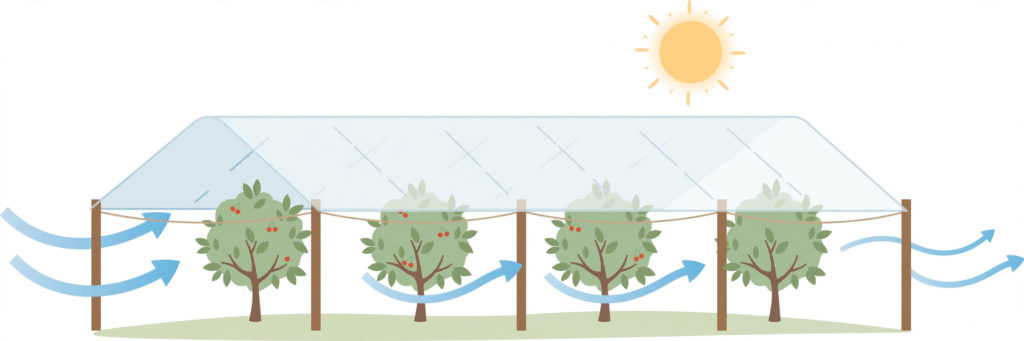
- Vent or retract after rain and on hot, still days; do not leave wet air sealed in.
- Never leave the cover closed and unattended through a heat spell.
- Check for water pooling on the cover after heavy rain and clear it before the weight builds.
A cover is not a fit-and-forget product. Managed actively, its disease balance is strongly positive; sealed and ignored, it can create the conditions it was meant to prevent.
Fixed Cover or Retractable System? The Choice Above the Fabric
Every section so far assumes a fixed cover: fabric deployed over a structure for the harvest window, then taken down. There is a second architecture worth knowing about before you buy fabric — the retractable system, where the cover runs on cables or tracks and opens or closes on demand, up to fully automatic, app-controlled versions.
What retractable buys you is control of the trade-offs in this guide. Colour costs light? Open the cover on dry days and close it before rain. Humidity building underneath? Open and flush the air. The costs of covering do not disappear — they become manageable, at a price: retractable systems sit at the top of the published cost spectrum for orchard covering (US extension cost surveys put cable-tent covers around US$15–23K per acre and high tunnels around US$39–48K per acre, with fully automatic retractable systems above both — US figures, given for scale, not as quotations).
| Your situation | Likely answer |
|---|---|
| Standard orchard, seasonal rain risk, cost per hectare matters | Fixed cover — the economics of this guide |
| High-value bicolour blocks in a low-light region, labour for daily operation available | Retractable deserves a quote — you are buying back light and air control |
| You want one supplier to design, install and guarantee the whole system | You are shopping for a system integrator, not a fabric — judge quotes on engineering and references, not cost per square metre |
One fabric warning if you go retractable: a cover that slides and rolls daily lives a different life from one that hangs still for a month. Abrasion at the fold and selvage strength become the deciding specs, and they are not the specs fixed-cover listings advertise. Whatever fabric a system quote includes, ask how it is rated for repeated movement — and if you are sourcing fabric separately for a retractable frame, confirm the duty cycle with the fabric maker before ordering.
Decision 2: Choose the Width from Your Row Spacing
The working formula is simple:
Cover width = row spacing + anchoring overlap on both sides
The cover has to shed water past the canopy, not onto it. Start from your row spacing and canopy width, then pick the nearest standard width:
| Your situation | Suggested width |
|---|---|
| Narrow canopy, single-row cover, tight spacing | 1.8 m |
| Standard commercial cherry rows | 2.0 m |
| Wide canopy or generous overhang wanted on both sides | 2.4 m |
| Wider rows, multi-row systems, unusual trellis | Custom width |
If you are between sizes, go one size up: an overlap sheds water, a short edge drips it onto the fruit. Note that single-row covers and multi-row systems follow different width logic — on wide or multi-row plantings, treat the width as a custom calculation, not a catalogue pick. When you enquire, the two numbers that matter most are your row spacing and canopy width — with those, a supplier can confirm the width in one step.
→ See the standard sizes and full specifications on the Orchard Rain Cover product page
Decision 3: Woven Cover or Film Cover?
Both keep rain off. They differ in what they cost you over several seasons:
| Woven HDPE rain cover | Blown anti-drip film | |
|---|---|---|
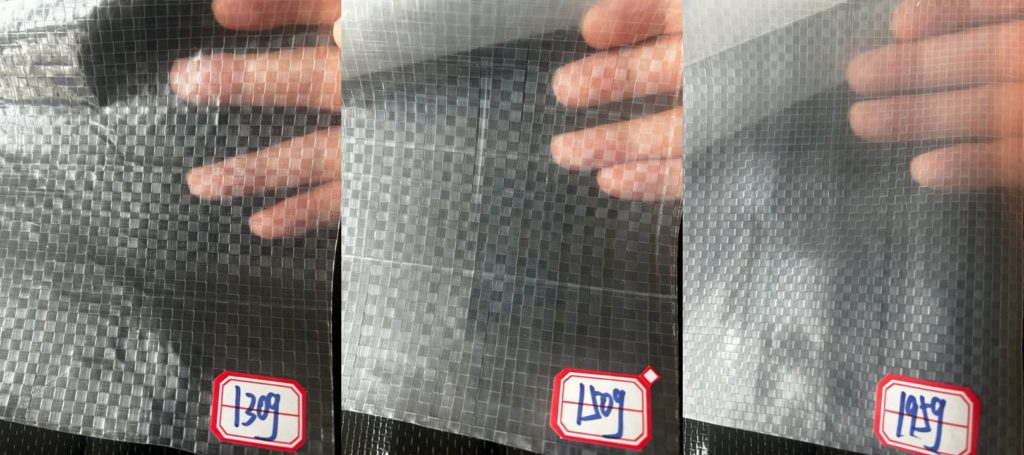
| Structure | Woven fabric, LDPE laminated on both sides | 3-layer blown film |
| Strength | High tear resistance; the fabric itself carries the load | Lower; fixing points are the weak spot in wind |
| Eyelets & fixing | Eyelets can be set directly into the reinforced (4-layer taped) selvages | Needs folded hems or extra reinforcement before eyelets will hold |
| Anti-drip | Available as a made-to-order option (not a regular stock item) | Available on anti-drip grades as a standard option |
| Light | Somewhat lower transmission; see the variety note below | Higher transmission |
| Season pattern | Deployed at colour change, removed after harvest, stored and re-used | Often left in place or treated as a shorter-life cover |
| Cost per season | Higher price per square metre, spread across every harvest it protects | Lower purchase price; a torn film is replaced at full price |
Honest cost note: compare covers per season of use, not per square metre. A woven cover that is deployed, removed and stored properly divides its price by every harvest it serves.
A variety note that changes the answer for some growers: covering reduces the light reaching the fruit, and colour development depends on that light. Bicolour varieties (Rainier types), whose colour sits only in the skin, are the most sensitive — in low-light districts, think twice and manage deployment timing carefully. Red varieties (Bing, Sweetheart types), coloured through skin and flesh, tolerate covering far better. If you grow bicolour cherries, tell your supplier the variety before the material is chosen, not after.
Decision 4: Fitting, In-Season Management and Removal Checklist
- Check the support wires or structure before the cover goes up — the cover is only as secure as what it is fixed to.
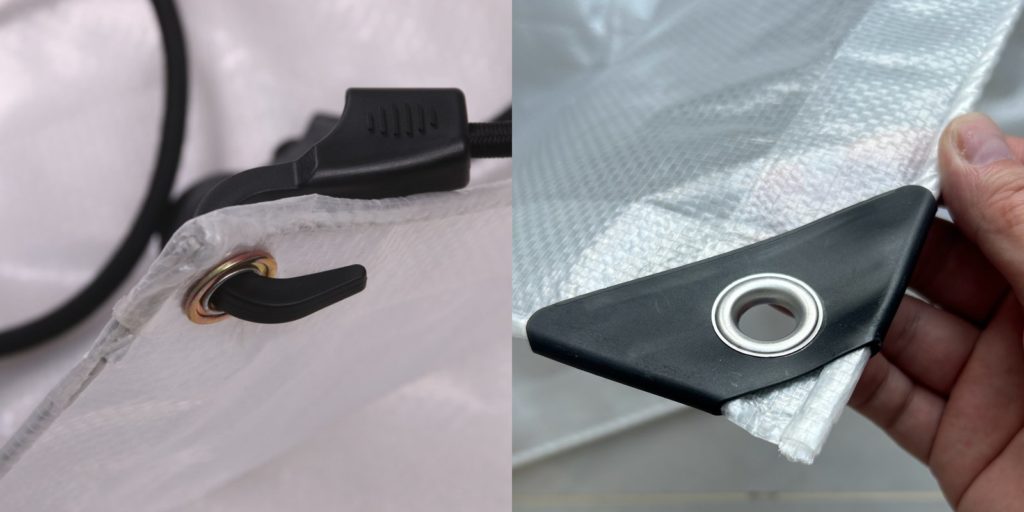
- Fasten along the reinforced selvages and eyelets, not through the middle of the fabric, and use elastic cord where you can — it buffers wind gusts instead of tearing at the fixing point.
- Keep the cover clear of sharp branch ends that can chafe holes during wind.
- After rain, and on hot still days, open the sides or retract to vent — see the microclimate section above.
- After heavy rain, check for pooled water on the cover and clear it.
- At removal, take the cover down dry where possible, roll rather than fold, and store it out of direct sun.
- Note any damaged spots at storage time, not at next season's colour change, when there is no time to repair them.
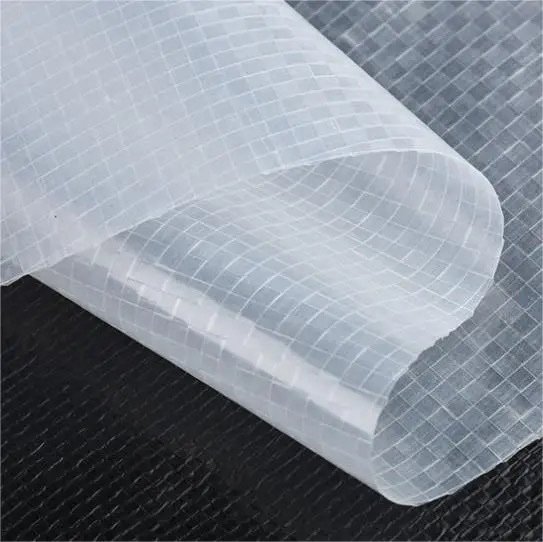
→ The same woven material works as a greenhouse cover — see the Woven Greenhouse Film page
FAQ
When should a cherry rain cover be put on?
Deploy it at colour change — about three to four weeks before harvest, when the cracking-risk window opens — and remove it right after harvest. The support structure is installed separately, in winter or early spring. In Chile that means deploying in the weeks before the November–January harvest window.
What width of cherry rain cover do I need?
Use the formula: row spacing plus anchoring overlap on both sides. Standard widths are 1.8 m, 2.0 m and 2.4 m; wider or multi-row systems use custom widths. If between sizes, choose the larger one so water sheds past the canopy.
Will a rain cover increase disease under the cover?
The trial evidence points the other way: by keeping the fruit surface dry, covers reduced rot from 16.5–48% (uncovered) to 1.8–11% (covered). The risk is not the cover itself but a sealed, unventilated one — high humidity builds up in closed systems. Open-sided row covers, vented after rain, keep the balance positive.
Does covering affect fruit colour?
Yes, somewhat: covering reduces the radiation reaching the fruit, and colour develops in response to light. Bicolour varieties such as Rainier are the most affected; red varieties are more tolerant. Taking the cover off in the final days to push colour is possible, but it re-opens the cracking risk if rain falls — it is a trade-off to make with the weather forecast in hand, not a routine step.
Is a woven rain cover better than a film rain cover?
For orchard rain protection, usually yes: woven HDPE is stronger at the fixing points, takes eyelets directly in its reinforced edges, and tolerates being deployed and removed every season. Film wins on light transmission and anti-drip, which matter more for greenhouse covering than for a few weeks of rain protection.
Can one cover protect grapes or passionfruit too?
Yes — the same woven rain cover is used over grape and passionfruit plantings. The selection logic is identical: crop timing, width from row spacing, and removal after harvest.
What should I send to get a correct quotation?
Your crop and variety, row spacing, canopy width, and the area to cover. With those, width and quantity can be confirmed without back-and-forth.
Before You Enquire
A rain cover is a small purchase compared with the crop under it. Get the four decisions right — timing, width, material for your variety, and the in-season management routine — and the cover stops being an emergency buy and becomes part of the orchard’s season plan.
→ See sizes and specifications on the Orchard Rain Cover product page (/product/orchard-rain-cover/), or send us your row spacing, canopy width and variety, and we will confirm the width and material for your orchard.
Orchard Rain Cover — woven HDPE, standard widths 1.8 / 2.0 / 2.4 m, MOQ 1,000 m², 5-year warranty